imageat is our first Fastlane AI alternative for brands that want to turn proven TikTok and Instagram formats into product-focused videos, slideshows, hooks, and memes. Fastlane is broader marketing automation; imageat Trend Studio is the stronger fit when your immediate bottleneck is finding a timely format, adapting it to your brand, and shipping a ready-to-post creative without building every concept from scratch.
The right alternative still depends on the job. Arcads is more focused on AI actors. Creatify emphasizes product-to-ad automation. Billo and Insense use human creators. Runway and CapCut give editors more manual control. This guide compares those different approaches instead of pretending every UGC tool solves the same problem.
Disclosure and methodology: imageat publishes this comparison and is listed first. We reviewed current product pages and workflows on November 3, 2026, but did not run a controlled output test across every competitor. We compare creative starting point, formats, product workflow, editing, localization, publishing, rights, and likely trade-offs. Competitor features and prices can change, so verify current plan terms before purchasing.
Fastlane AI alternatives at a glance
- imageat Trend Studio — our first choice for trend-first product ads. Start with a proven social format, adapt it to your business, render a vertical post, and download or schedule it.
- Arcads — best for AI actor-led ad variations. A direct choice when scripts and synthetic creator performances are the center of the workflow.
- Creatify — best for product-to-video automation. Useful for teams that want to turn product information into batches of ad concepts.
- Captions — best for generation plus social editing. A broad workflow for creating, captioning, revising, and polishing short-form content.
- HeyGen — best for multilingual avatar campaigns. Stronger when translation, reusable avatars, and localized presenter delivery matter.
- Billo — best for real product handling. Human creators can receive, open, wear, taste, or demonstrate a physical product.
- Insense — best for creator sourcing and usage rights. Better suited to collaboration and human UGC campaign operations.
- TikTok Symphony — best for TikTok-centered advertisers. Platform-native creative assistance for teams working mainly inside TikTok.
- Runway — best for custom visual generation. Offers more art direction but requires the team to assemble the ad workflow.
- CapCut — best for hands-on short-form editing. Useful for finishing creator clips, AI scenes, captions, templates, and product demos.
What is Fastlane AI?
Fastlane is an AI marketing platform designed to move from brand research to creative production, campaign launch, and performance learning. Its current workflow can learn a brand from a website URL, analyze existing ads and competitors, generate multiple creative concepts, launch paid and organic campaigns, schedule social posts, and use performance signals to create new variations.
Its creative formats extend beyond talking-head UGC. Fastlane currently presents AI creators, statics, memes, competitor remixes, trend-inspired formats, and other short-form concepts. That breadth is important: a genuine Fastlane replacement must be judged against the part of Fastlane you use, not just against its AI presenters.
Fastlane's current public pricing, checked November 3, 2026, starts at $29 per month for 500 credits. Its Growth, Pro, and Enterprise tiers list larger credit allowances, more campaigns, social accounts, seats, characters, and analytics features. The site also advertises a seven-day trial with 50 credits. These details are a snapshot, not a promise for 2027.
Why look for a Fastlane AI alternative?
Fastlane may already be a strong fit if you want one system to research a market, create many ads, schedule posts, launch paid campaigns, and learn from creative performance. Teams usually consider alternatives because they need a different balance of depth and breadth.
You may want another tool if:
- Trend selection is the real bottleneck. You need a simpler way to find a recognizable social format and rebuild it for your product.
- AI actor performance matters most. You want deeper control over presenter style, delivery, language, or batch variations.
- A real person must handle the product. Synthetic video cannot honestly demonstrate every physical experience.
- Your team needs precise editing. You want a timeline, scene-level revisions, captions, and manual pacing control.
- Localization is central. Translation, pronunciation, voice, and lip sync may matter more than campaign automation.
- You already have publishing and analytics. Paying for another complete marketing system may duplicate your existing stack.
- You want to test one part of the workflow first. A focused tool can be easier to evaluate than a platform that changes research, production, publishing, and measurement at once.
How we compared the alternatives
A useful comparison should go beyond avatar counts and promotional demos. We used seven practical questions:
- Where does the workflow begin? A trend, URL, product image, script, creator brief, or blank editor?
- What does it produce? Talking-head UGC, slideshows, memes, product demos, avatar videos, or custom scenes?
- How well does it protect the product? Packaging, colors, proportions, logos, and physical behavior must remain credible.
- Can a team create variations efficiently? The best workflow separates hooks, scripts, presenters, scenes, captions, and calls to action.
- What happens after generation? Editing, approval, export, scheduling, paid-ad launch, and analytics may live elsewhere.
- What rights and disclosures are required? Commercial terms, creator usage windows, avatar consent, music rights, and AI disclosure matter.
- What is the main trade-off? Every tool gives up something: authenticity, control, speed, breadth, simplicity, or cost predictability.
The 10 best Fastlane AI alternatives for UGC ads
1. imageat Trend Studio — best for trend-first product ads
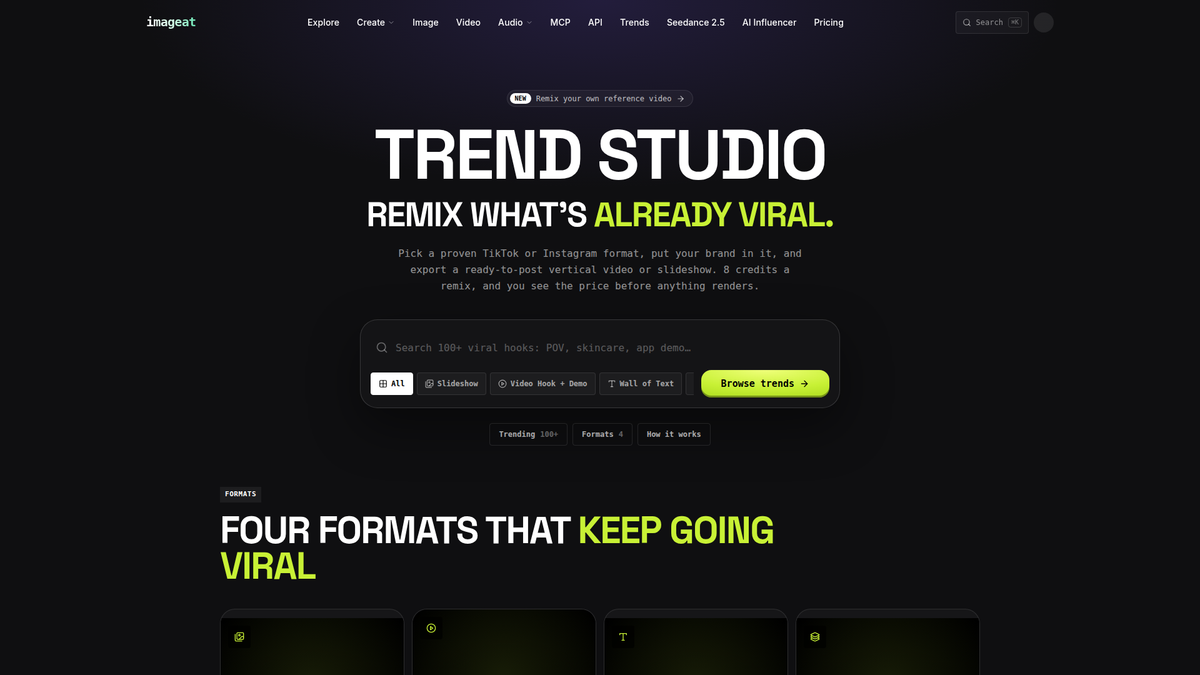
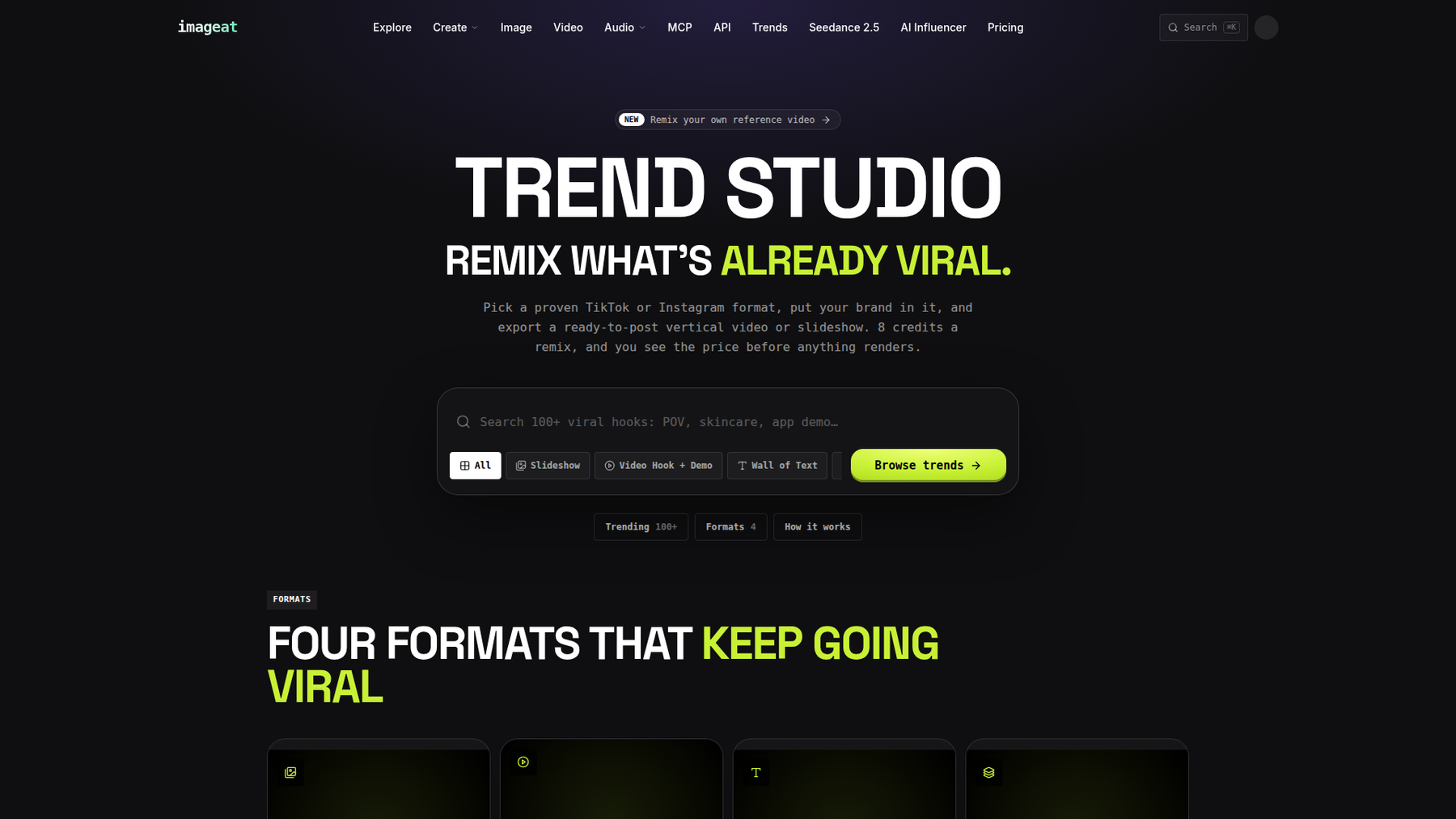
imageat Trend Studio is our first recommendation when a team needs fresh social concepts more than another all-in-one marketing agent. It starts with the format viewers recognize, then helps rebuild that structure around the brand.
The current workflow includes four format families:
- Slideshow: image-led stories with a strong first-slide hook.
- Video Hook + Demo: a social-native opening stitched to a product or screen-recording demo.
- Wall of Text: text-led posts built around saves, shares, or comments.
- Green Screen Meme: a reaction or meme structure placed over the brand's visual.
You can browse more than 100 formats by niche, add your business, generate hook options, select a caption style and sound, and render the finished vertical creative. You can also upload a reference video you have permission to use. Trend Studio extracts the hook, sequence, captions, and pacing into an editable blueprint so the concept can be rebuilt for your brand rather than copied frame for frame.
Each remix currently costs eight imageat credits, and the cost is visible before rendering. The MP4 can be downloaded or scheduled through imageat Social Hub. Current imageat pricing also shows credit allowances before purchase, so teams can estimate the number of remixes their plan supports.
How it differs from Fastlane: Fastlane aims to run a broader marketing loop, including research, creative generation, campaign launch, and performance learning. Trend Studio is more focused: discover a social format, adapt it to the brand, create the asset, and post or schedule it.
Choose imageat when: your team repeatedly asks what to make next; you need trend-aware product creatives across niches; or you want slideshows, hook-and-demo videos, text formats, and memes without centering every ad on an AI presenter.
Main limitation: Trend Studio does not replace media buying, campaign analytics, influencer distribution, or a human creator's real experience. A recognizable format can improve creative relevance, but no tool can guarantee virality, reach, or sales.
2. Arcads — best for AI actor-led variations
Arcads is one of the closest alternatives when the main requirement is synthetic creator-style performance. Its workflow centers on scripts delivered by AI actors, which makes it suitable for direct-response teams testing different hooks, faces, and deliveries.
How it differs from Fastlane: Arcads is narrower and more presenter-focused. Fastlane spans multiple formats, scheduling, and campaign operations; Arcads is better understood as a specialist for actor-led UGC-style clips.
Choose Arcads when: you already have a product angle and scripts, and your next step is producing many talking-head executions for testing or localization.
Main limitation: a convincing presenter is not a complete ad strategy. Teams may still need product cutaways, demonstrations, captions, editing, approvals, and publishing elsewhere. Compare actual export quality, revision costs, language support, and commercial terms before committing.
3. Creatify — best for product-to-video automation
Creatify focuses on AI advertising workflows that can turn product information into video concepts, including avatar-led and UGC-style ads. It is relevant to ecommerce teams and agencies that need repeatable production across a catalog.
How it differs from Fastlane: both tools can begin with product or brand information, but Creatify is more directly framed around generating advertising assets and variations. Fastlane's current positioning extends further into research, paid and organic launch, and feedback loops.
Choose Creatify when: URL-to-ad automation, batch variations, and product-centered advertising are more important than broad social marketing operations.
Main limitation: automation can reproduce weak claims or inaccurate product details at scale. Review every script, visual, price, offer, and product representation before launch. Editing depth and available features may also vary by plan.
4. Captions — best for AI ads plus social editing
Captions combines AI-generated social video with a wider editing environment. That makes it useful for teams that need to revise pacing, subtitles, framing, delivery, and final polish after generation.
How it differs from Fastlane: Captions is closer to a creation and editing suite, while Fastlane is moving toward an end-to-end marketing system. Captions may fit better when a creator or social team wants more control over the finished clip.
Choose Captions when: the team values one environment for generation, captions, visual cleanup, and social-video finishing.
Main limitation: an integrated editor does not automatically supply a strong campaign angle or accurate product demonstration. Judge the workflow from initial brief to usable export, not from the quality of one feature demo.
5. HeyGen — best for multilingual avatar campaigns
HeyGen is an adjacent alternative for teams that prioritize avatars, voices, translation, and localized presenter delivery. It can work well for product explainers, campaign adaptations, and reusable presenter workflows.
How it differs from Fastlane: HeyGen is fundamentally an avatar-video platform. Fastlane combines creative research, multiple formats, social operations, and campaign learning. HeyGen is the more focused choice when localization and presenter consistency are central.
Choose HeyGen when: you need the same message delivered across languages or want reusable avatar-led videos for multiple markets.
Main limitation: polished avatar video can feel more like a business explainer than native UGC. Strong hooks, product footage, quicker cuts, platform-specific captions, and human review may still be required.
6. Billo — best for real product handling
Billo connects brands with human creators who produce product videos. It is a fundamentally different alternative, but an important one when the campaign depends on someone physically opening, wearing, tasting, assembling, or using a product.
How it differs from Fastlane: Billo uses human production rather than synthetic actors and automated creative generation. The process includes a brief, creator coordination, product shipping where necessary, filming, delivery, and revisions.
Choose Billo when: real hands, a real environment, and a creator's natural delivery matter more than instant generation.
Main limitation: turnaround is measured in days rather than minutes. Costs, revisions, shipping, creator fit, and paid-ad usage rights require more coordination. A creator should not make unsupported product claims simply because the video is authentic.
7. Insense — best for creator sourcing and rights management
Insense is better viewed as a creator collaboration and UGC campaign platform than as a one-click generator. It is useful when the operational challenge is finding creators, briefing them, managing approvals, and securing the right usage terms.
How it differs from Fastlane: Fastlane automates research, generation, and campaign execution. Insense helps organize human creator production and collaboration.
Choose Insense when: creator selection, communication, licensing, and human-made content are the core needs.
Main limitation: it cannot deliver the instant variation of a generative platform. Campaign scope, creator costs, revision limits, content rights, and distribution arrangements should be reviewed carefully.
8. TikTok Symphony — best for TikTok-native advertising
TikTok Symphony is a generative creative suite built for advertisers in TikTok's ecosystem. Its proximity to platform-native creative tools and ad workflows can be useful for teams concentrated on TikTok.
How it differs from Fastlane: Symphony is platform-specific. Fastlane is designed for a broader cross-platform marketing loop that includes TikTok, Instagram, and Shorts.
Choose TikTok Symphony when: TikTok is the primary channel and the team values native creative assistance inside the advertising ecosystem.
Main limitation: features and availability can vary by region and account. A TikTok-first workflow may not transfer cleanly to Reels, Shorts, or other placements.
9. Runway — best for custom visual generation
Runway is a general generative video platform rather than a dedicated UGC ad system. Its strength is visual experimentation: custom scenes, transitions, campaign footage, stylized product moments, and art-directed sequences.
How it differs from Fastlane: Runway provides creative generation tools but does not inherently supply the brand research, ad strategy, UGC structure, publishing, or performance loop that Fastlane targets.
Choose Runway when: an experienced creative team wants custom visuals that do not fit a template or avatar-led workflow.
Main limitation: flexibility creates more work. The team must bring the hook, script, product safeguards, edit, captions, rights review, platform packaging, and distribution plan.
10. CapCut — best for hands-on short-form editing
CapCut is a practical alternative for teams that want a familiar editing timeline, templates, captions, effects, and manual control. It can assemble creator clips, AI-generated footage, demonstrations, voiceovers, and trend-inspired edits.
How it differs from Fastlane: CapCut is primarily an editing and creative-production environment. Fastlane automates more of the upstream research and downstream campaign workflow.
Choose CapCut when: the team already has concepts and footage but wants direct control over pacing, text, transitions, audio, and final exports.
Main limitation: it usually requires more manual assembly than a dedicated product-to-ad generator. Feature availability and commercial-use terms for templates, audio, and assets can vary by region and product tier.
Fastlane versus imageat: which workflow fits you?
Choose Fastlane when you want one platform to learn the brand from a URL, study competitors and customers, create many ad concepts, launch paid and organic campaigns, schedule content, and use performance data to generate the next batch.
Choose imageat Trend Studio when the immediate task is narrower and faster: find a proven TikTok or Instagram format, rewrite it for the brand, produce a vertical slideshow or video, and download or schedule the result.
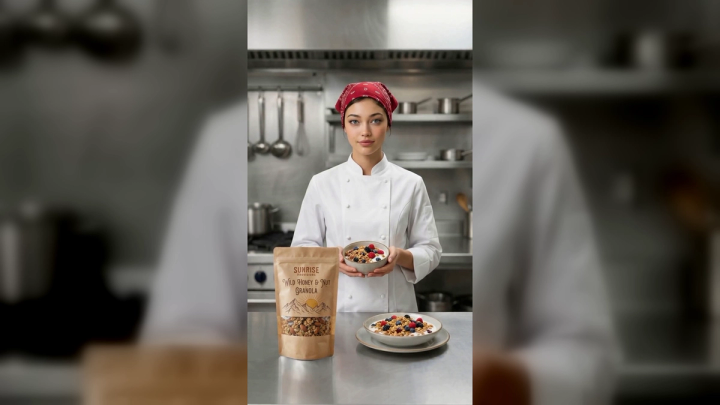
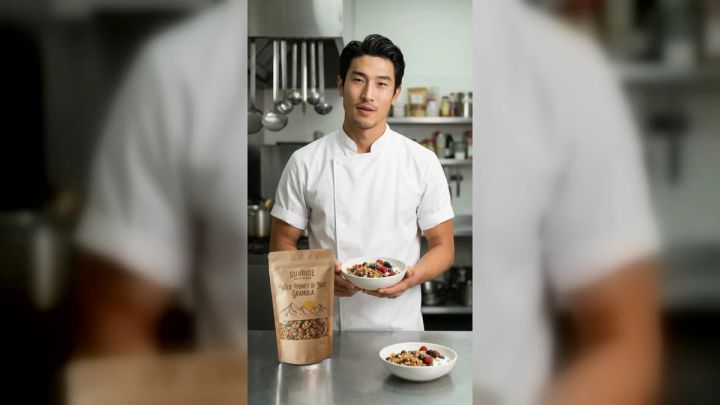
Choose the imageat AI UGC generator when you already have a product image and script and specifically want a virtual presenter. The current workflow accepts a product image, an optional model image, a scene or effect type, and a script. That is a better fit for creator-style product introductions, routines, demonstrations, and spoken ads.
These imageat workflows can also be combined:
- Find the format and hook in Trend Studio.
- Prepare supporting product visuals with the AI product photo generator.
- Create a presenter-led segment with the AI UGC generator when the concept needs a spokesperson.
- Build additional footage with the AI video generator.
- Refine speaking footage with AI lip sync when necessary.
- Download or schedule approved content through Social Hub.
For a detailed production walkthrough, read our guide to making AI UGC videos for TikTok, Reels, and product ads.
How to calculate the real cost of a UGC ad tool
The subscription price is only one part of the cost. Use the same worksheet for every option:
- Monthly plan cost: include required seats and add-ons.
- Usable outputs: count approved creatives, not raw generations.
- Regeneration cost: determine whether every small revision consumes credits.
- Finishing cost: include another editor, caption tool, voice service, or scheduler if required.
- Human review time: scripts, claims, product details, pronunciation, hands, labels, and subtitles all need review.
- Rights cost: human creator usage windows, music, stock assets, and paid-ad permissions may be separate.
- Distribution cost: distinguish export-only tools from built-in scheduling or ad launch.
A simple formula is:
Effective cost per usable ad = total monthly production cost ÷ number of approved, campaign-ready ads.
For Trend Studio, each remix currently uses eight credits. The visible cost before render makes it easier to estimate a batch before production, but a team should still count rejected concepts and review time when calculating the real cost.
A practical migration plan from Fastlane
Switching tools without preserving the learning usually creates more work than it saves. Before moving, export or document:
- Your strongest hooks and scripts.
- Winning audience and offer combinations.
- Product images, demos, logos, fonts, colors, and brand rules.
- Approved claims and prohibited wording.
- Aspect ratios, caption styles, and platform-specific edits.
- Creative naming conventions and performance results.
- Connected accounts, schedules, and approval responsibilities.
Then recreate one proven campaign in the alternative before rebuilding the entire workflow. Compare setup time, usable outputs, revision effort, product accuracy, publishing steps, and campaign performance. Do not judge a migration from one attractive demo video.
Frequently asked questions
What is the best Fastlane AI alternative for UGC ads?
imageat is our first recommendation for teams that want trend-first product ads. Trend Studio turns proven TikTok and Instagram structures into branded slideshows, hook-and-demo videos, wall-of-text posts, and green-screen formats. Arcads is more specialized for AI actors, while Billo or Insense may be better when a real human creator is required.
Is imageat the same type of platform as Fastlane?
No. Fastlane currently positions itself as a broader AI marketing system covering research, creative generation, launch, scheduling, and performance learning. imageat Trend Studio focuses on discovering and adapting social formats. Other imageat tools cover presenter-led UGC, product photos, AI video, lip sync, and scheduling, so teams can assemble the parts they need.
Is there a free alternative to Fastlane AI?
Free plans and trials change frequently. Fastlane currently advertises a seven-day trial with limited credits. Some competing tools also advertise free or trial access, often with watermarks, short duration caps, or limited exports. Compare whether the trial produces a commercially usable file rather than choosing on the word “free” alone.
Which alternative is best for ecommerce product videos?
Trend Studio is a strong fit when an ecommerce brand needs product-focused concepts based on social formats. Creatify is relevant for product-to-ad automation, while Billo can be better when a real creator must physically use the product. The best choice depends on whether the ad needs a trend, synthetic presenter, automated catalog workflow, or genuine demonstration.
Can AI UGC replace real creators?
Not completely. AI UGC can accelerate ideation, variation, localization, and pre-shoot testing. Real creators remain valuable for authentic product handling, personal delivery, lived experience, and creator-led distribution. A practical strategy is to test hooks with AI, then brief human creators using the strongest concepts.
Can AI-generated UGC be used in paid social ads?
Often yes, subject to the tool's commercial terms, the platform's current rules, and the rights attached to every asset. Do not present a synthetic person as a real customer or imply product experience that never occurred. Review music, voice, avatar, product, trademark, and disclosure requirements before launching.
What should I check before using an AI avatar commercially?
Confirm avatar consent, commercial usage rights, voice permissions, retention terms, export restrictions, disclosure requirements, and prohibited use. Review the final clip for misleading testimonials, inaccurate claims, identity confusion, and manipulated product results. imageat's responsible-use guidance prohibits impersonation, deepfakes, and voice cloning misuse.
How should I test Fastlane alternatives?
Use the same product, audience, offer, target duration, aspect ratio, and three scripts. Score each tool for setup time, first-pass quality, product fidelity, speech, revisions, captions, export, rights, and publishing. Then calculate cost per approved creative. A single polished vendor demo is not a fair comparison.
Does a trending format guarantee views or sales?
No. A recognizable format can help a creative feel native to the feed, but performance still depends on timing, audience, product-market fit, hook, offer, distribution, media buying, and landing-page quality. Treat each remix as a hypothesis and measure it against your own results.
Final recommendation
Fastlane is no longer just an AI UGC generator; it is becoming a broader system for research, creative generation, campaign execution, and performance learning. The best alternative therefore depends on which part of that system you actually need to replace.
Start with imageat if your priority is creative freshness. Open Trend Studio, choose a proven social format, adapt it to your business, and build the first campaign variation. Use the AI UGC generator when the concept needs a presenter, add product visuals or supporting video where necessary, and schedule the approved result through Social Hub.
Choose another category only when the job clearly demands it: Arcads for AI actor depth, Creatify for product-to-ad automation, HeyGen for multilingual avatars, Billo or Insense for human creators, TikTok Symphony for TikTok-native workflows, or Runway and CapCut for greater manual control. The right tool is the one that removes the real bottleneck without adding features your team will not use.